Fitting Solar to Heritage Church Buildings: 6 Key Considerations
Preserving history through solar: specialist care for fragile roofs, ancient timbers, and stone walls.
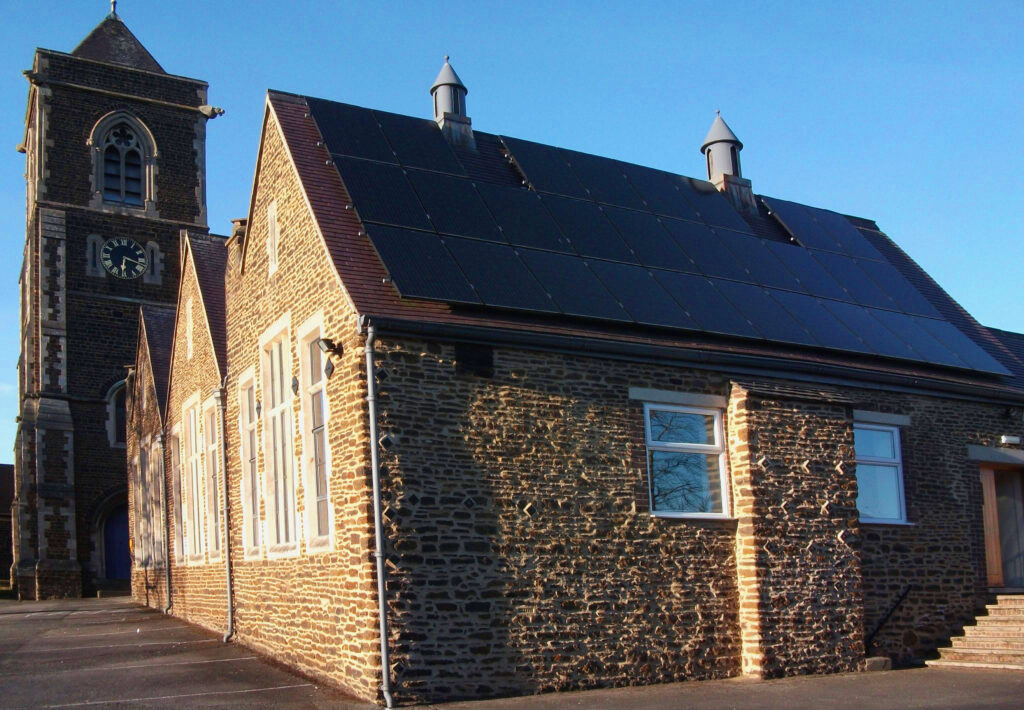
1. Old rosemary and slate tiles
The roof of a church is often its most beautiful—and delicate—feature. Traditional rosemary (clay) and slate tiles can become brittle over time, requiring a careful hand during any installation.
- The Challenge: These tiles are prone to cracking under pressure and often lack the uniform dimensions of modern materials. Even without pressure, sometimes just handling them can cause them to crack.
- Our Solution: We use specialist mounting systems designed to distribute weight evenly without compromising the tiles. By using special “rubber replacement tiles”, we evenly redistribute the weight of the system in a way that minimises pressure on exisiting tiles, and combined with our installers experienced in working with fragile materials, ensure that the water-tight integrity of your roof is maintained while your new solar system is secured.
2. The presence of asbestos
Many historic buildings, or their later additions, contain asbestos within the roofing materials or insulation. Safety and compliance are our absolute priorities here.
- The Challenge: Asbestos requires expert handling to ensure no fibres are released during the installation of solar fixings. It’s important to make sure that we indentify the correct type and form of asbestos in order to know the best way to deal with it effectivly.
- Our Solution: We never take risks with your health or the building’s safety. If asbestos is suspected, we only work alongside fully qualified specialists licensed to handle and remediate these materials. We ensure all work is carried out to the highest UK safety standards before your solar system is commissioned.
3. Lack of roof membranes
Unlike modern builds, many older church roofs were constructed without a breathable sarking membrane. This means there is no secondary line of defence against the elements beneath the tiles.
- The Challenge: Without a membrane, there is a slightly higher risk of wind-driven rain or condensation entering the roof space if tiles are disturbed.
- Our Solution: We perform a detailed pre-installation assessment to check the health of your roof. We then use high-quality flashings and weathering components specifically designed for non-membraned roofs, ensuring your building remains dry and protected for decades to come.
4. Truss and rafter systems
The "skeleton" of a church roof is often a complex arrangement of heavy timber trusses and rafters. Understanding the load-bearing capacity of these historic structures is vital.
- The Challenge: Adding solar panels introduces a new "dead load" (the weight of the panels) and "wind load" (the force of the wind) to old timbers.
- Our Solution: We don't guess when it comes to your building’s bones. We engage specialist structural surveyors to calculate exactly how much weight your roof can safely hold. We then combine this with industry guidance on load thresholds, ensuring your solar installation is as robust as the building itself, meeting all current building regulations.
5. Tricky cable runs
Churches are famous for their vast open spaces and thick stone walls, which can make routing cables from the roof to the inverter and battery a creative challenge.
- The Challenge: We want to avoid visible "surface-mounted" plastic trunking that could detract from the internal beauty of the nave or sanctuary.
- Our Solution: We treat cable routing as an art form. By using existing voids, redundant chimneys, or discreet external routes, we ensure the "green" technology stays tucked away. Our goal is for the only visible sign of your transition to solar to be the lower energy bills.
6. Lightning protection
Many churches are already equipped with lightning conductors. Integrating a solar array into a building with an existing protection system requires technical precision.
- The Challenge: Solar panels are metallic and mounted at height, meaning they must be correctly "bonded" to the building’s lightning protection system to prevent surges.
- Our Solution: Where necessary, we work with our roofing specialists to ensure your solar system is fully integrated into your existing surge protection. This protects your investment—and your building—from the unpredictable UK weather, giving you total peace of mind.
- The Challenge: These tiles are prone to cracking under pressure and often lack the uniform dimensions of modern materials. Even without pressure, sometimes just handling them can cause them to crack.
- Our Solution: We use specialist mounting systems designed to distribute weight evenly without compromising the tiles. By using special “rubber replacement tiles”, we evenly redistribute the weight of the system in a way that minimises pressure on exisiting tiles, and combined with our installers experienced in working with fragile materials, ensure that the water-tight integrity of your roof is maintained while your new solar system is secured.
Ready to see what you can save?
Our solar calculator is 100% free to use. Enter your postcode below to get started.